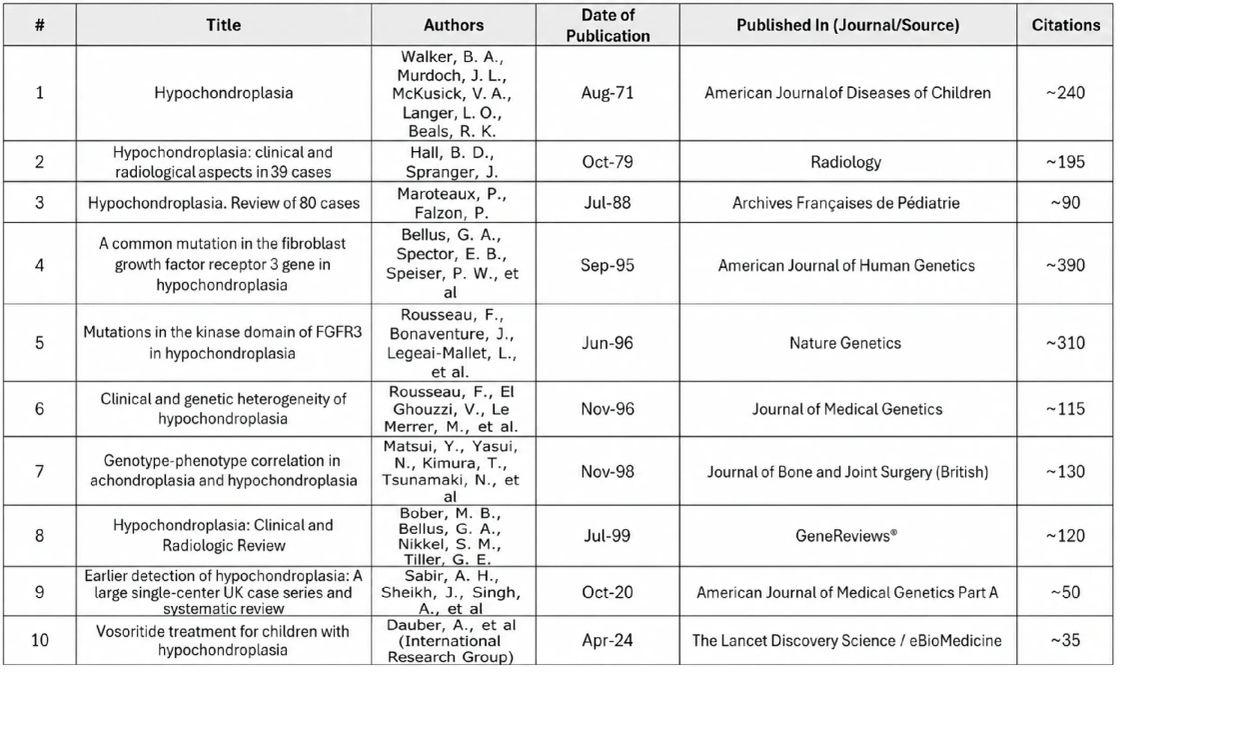
1924: The condition received its enduring name.
André Léri and Alice Linossier introduced the term hypochondroplasie in their paper, Hypochondroplasie héréditaire. This was a foundational naming and classification milestone.
Source: https://books.google.com/books?id=eT1EAQAAIAAJ&pg=PA1780
1964: Early clinical and radiographic definition of hypochondroplasia.
Kazimierz Kozłowski and Czesław Zychowicz published an important paper that helped distinguish HCH from achondroplasia and other skeletal dysplasias.
Source: https://pubmed.ncbi.nlm.nih.gov/14337160/
1969–1971: HCH became firmly established as a distinct inherited skeletal dysplasia.
Family studies clarified its clinical characteristics, radiographic findings and autosomal-dominant inheritance.
Sources:
https://pubmed.ncbi.nlm.nih.gov/5783850/
https://pubmed.ncbi.nlm.nih.gov/5564166/
1994–1995: The genetic basis was discovered.
HCH was mapped to chromosome 4p16.3, and the common FGFR3 p.Asn540Lys variant was identified. This enabled molecular diagnosis, genetic counselling, family testing and prenatal testing.
Sources:
https://www.nature.com/articles/ng0394-318
https://www.nature.com/articles/ng0795-357
2012: Neurological involvement received major recognition.
Research linked HCH, particularly N540K-related HCH, with temporal-lobe abnormalities, epilepsy and neurodevelopmental difficulties. This strengthened the case for neurological and developmental monitoring.
Source: https://pubmed.ncbi.nlm.nih.gov/23165795/
2024: The first positive prospective trial of a targeted HCH treatment.
Vosoritide increased annualised growth velocity by approximately 1.81 cm per year and was generally well tolerated.
Source: https://pubmed.ncbi.nlm.nih.gov/38813446/
May 2026: The first successful pivotal Phase 3 trial in HCH.
CANOPY-HCH-3 reported a 2.33 cm-per-year improvement in annualised growth velocity compared with placebo, together with improvements in standing height and arm span. Vosoritide is not yet approved specifically for HCH.
Source: https://www.biomarin.com/news/press-releases/biomarin-announces-positive-phase-3-pivotal-study-results-for-voxzogo-vosoritide-in-children-with-hypochondroplasia/
July 2026: The lifelong medical complications of HCH was documented at population level.
A study of 549 people demonstrated substantial cardiovascular, respiratory, orthopaedic, ENT and mental-health burden. It strengthened the case for coordinated multidisciplinary care throughout life.
Source: https://www.sciencedirect.com/science/article/pii/S8756328226002425
August 2026: Publication of the first international, multidisciplinary consensus-based diagnostic recommendations for HCH.
A global panel of multi-disciplinary experts for the first time in the history of HCH developed diagnostic categories for the use of molecular testing, imaging and radiographic evaluation.
Source: Nature Reviews Endocrinology